What Is a Hotel Channel Manager? Hotel Distribution, Explained by a Product Manager
What is a hotel channel manager? A PM who built lodging distribution explains ARI sync, OTAs, parity, and overbooking risks.
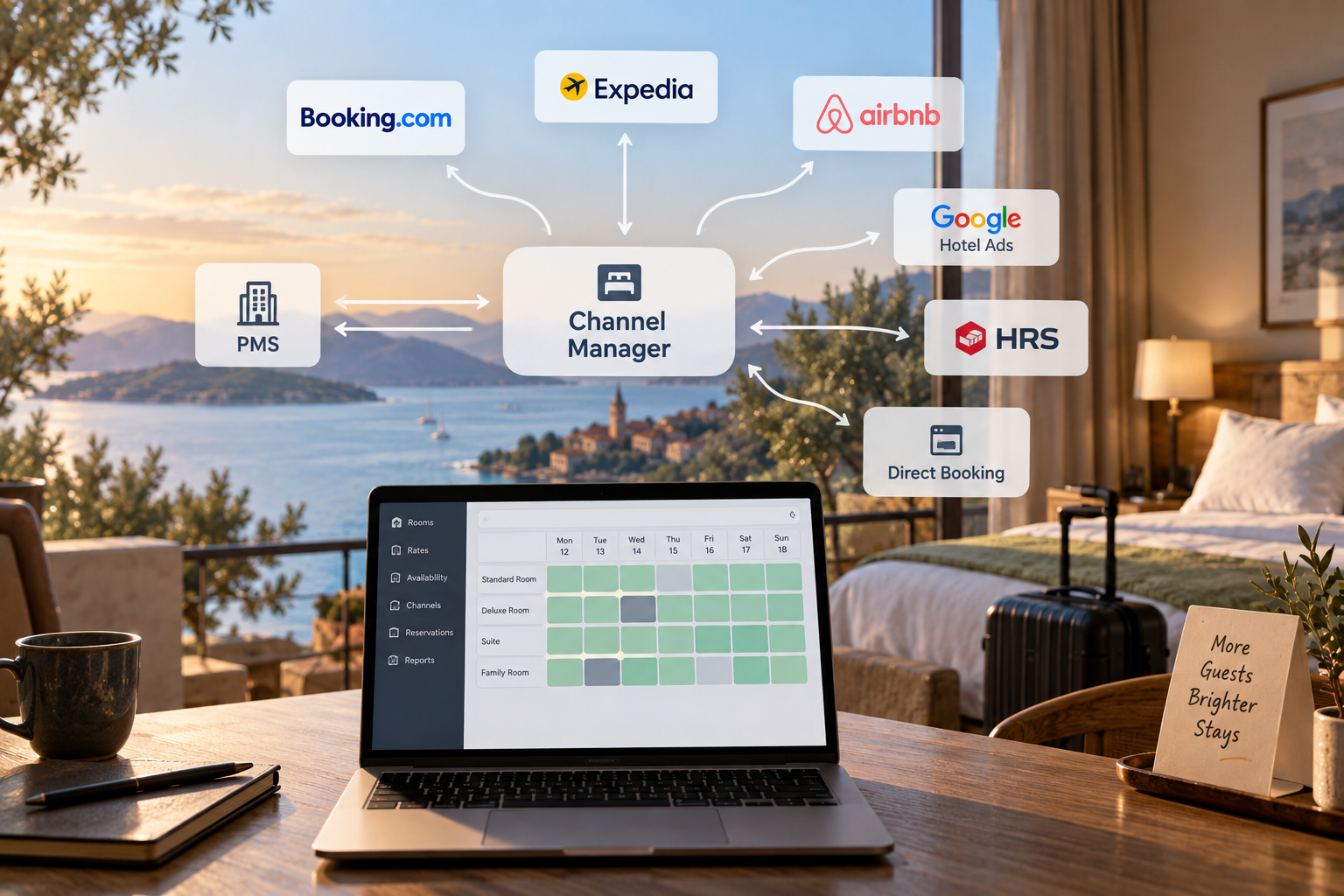
A hotel channel manager is software that connects a property’s inventory, rates, and availability to many sales channels at once—OTAs, metasearch, GDS, and the hotel’s own website—so the same room is not sold twice and prices stay consistent.
If you work in travel tech, lodging platforms, or hotel operations, that one-sentence definition is the core. The rest of this post unpacks how channel managers fit into hotel distribution, what “ARI sync” actually means, where products tend to break, and what to look for when you choose one. I write this as a product manager who has built lodging distribution products and later worked on marketplace / OTA-side experiences—so you get both sides of the pipe.
The hotel distribution chain
Think of distribution as a chain, not a single app:
- PMS (Property Management System) — the hotel’s system of record for rooms, guests, and on-property operations.
- Channel manager — the sync layer that pushes availability, rates, and inventory (ARI) out and pulls reservations back in.
- Channels — Booking.com, Expedia, Google Hotel Ads / metasearch, a GDS, a corporate booking tool, or the hotel’s direct booking engine.
Without a channel manager, a small hotel often updates each OTA by hand. That works until the first busy weekend: one channel sells a room the other still shows as free, and you get an overbooking. The channel manager’s job is to make “one source of truth for sellable inventory” real across every connected channel.
PMS → Channel manager → OTA / GDS / metasearch / direct web
← reservations, cancellations, modifications
What a channel manager actually does
ARI sync (availability, rates, inventory)
ARI is the heartbeat. When a hotel closes a date, changes a BAR (best available rate), or opens a promotion, the channel manager should propagate that change to every mapped channel within seconds or minutes—not hours. Slow sync is a silent revenue and reputation risk.
Reservation download
When a guest books on an OTA, the booking should land in the PMS (or at least in the channel manager inbox) with guest details, rate plan, room type, and payment / guarantee notes. Partial downloads—missing rate codes, wrong occupancy—create front-desk pain the same day.
Parity and consistency
Rate parity means the same publicly bookable rate appears consistently across channels (contract terms vary). Even when parity rules loosen, hotels still care that a promo on one channel does not contradict another. Channel managers often surface parity alerts; they rarely “enforce” contracts alone.
Overbooking prevention
The classic failure mode: two channels sell the last room before either update arrives. Good channel managers use tight inventory allotments, fast push, and sometimes stop-sell / threshold rules. No system is magic if the hotel oversells on the phone or via walk-in without updating the PMS.
How it works under the hood
Most modern setups are two-way: ARI goes out; bookings come back. Mapping is the hard part of setup:
- Room type mapping — PMS “DBL STD” must equal Booking’s “Double Standard” and Expedia’s equivalent.
- Rate plan mapping — BAR, non-refundable, breakfast-included, and corporate rates need distinct codes on each channel.
- Push vs pull — Push (hotel/channel manager sends updates) is common for OTAs; pull (channel fetches) still appears in older GDS-style flows. Latency characteristics differ.
When mapping is wrong, you do not get a clean error—you get wrong inventory sold at the wrong price. That is why onboarding quality matters as much as feature lists.
Where products get hard (from building them)
Having shipped lodging distribution UX, these are the failure modes I watch for:
- Mapping drift — channels rename rooms; hotels add rate plans mid-season; connectors go stale.
- Partial failure — one of twelve channels rejects an update; UI says “synced” while one OTA is stale.
- Opaque errors — XML/JSON fault codes dumped at hotel staff who only wanted to close tomorrow.
- Parity noise — constant alerts with no actionable fix train users to ignore them.
- Hotelier UX — if closing dates takes more than a few taps, people invent workarounds (and break sync).
Good product work here is boring in the best way: clear status per channel, retry queues, human-readable errors, and defaults that match how hotels actually work.
The other side of the coin: what OTAs and marketplaces need
From a marketplace / OTA product seat, channel managers are upstream partners. Marketplaces care about:
- Fresh availability (stale rooms destroy conversion and trust).
- Accurate content and rate plans (not just a single BAR).
- Reliable booking confirmation and modification flows.
- Compliance with channel rules (allotments, derived rates, stop-sell).
If you build on either side, optimize for the shared contract: correct ARI, fast, with clear failure modes. Feature marketing (“500+ channels!”) matters less than whether channel #47 stays healthy at 2 a.m. on a holiday weekend.
A short history of why this layer exists
Before channel managers were common, hotels treated each OTA as a separate storefront. Staff logged into multiple extranet panels, typed the same closed dates twelve times, and hoped nothing sold overnight. As OTAs multiplied and metasearch made price comparison one click away, that operational model collapsed. Channel managers emerged as the middleware that hotels (and later PMS vendors) needed so distribution could scale without a full-time “extranet person.”
Today the category overlaps with booking engines, CRS (central reservation systems), and PMS modules. Naming differs by vendor; the capability that matters is reliable multi-channel ARI plus reservation delivery. If a product calls itself a “connectivity hub” or “distribution platform,” ask the same questions: which channels are certified, how fast is sync, and what happens when one endpoint fails?
ARI in more detail
Availability answers “can I sell this room-night?” It may be a simple open/close or a count of allotments per channel. Rates are the prices attached to rate plans—often with derived rules (non-refundable = BAR minus 10%). Inventory is the count of sellable units; some setups push a shared pool, others push channel-specific allotments so the hotel can prefer direct or a contracted OTA.
Product teams underestimate how often hotels want exceptions: free-sell vs allotment, stop-sell by channel, length-of-stay restrictions, closed-to-arrival. A channel manager that only supports “one price, all channels” will frustrate anyone past a tiny B&B.
Onboarding is product, not a side quest
The first week decides whether the hotel trusts the tool. Strong onboarding includes guided mapping, sandbox/test bookings, a channel-by-channel go-live checklist, and a clear rollback if an OTA starts selling the wrong room. Weak onboarding dumps a spreadsheet of room codes and disappears. As a PM, I treat time-to-first-correct-sync as a north-star metric—not vanity channel counts.
Choosing a channel manager: a practical checklist
- Does it integrate cleanly with your PMS (certified connector, not a brittle CSV)?
- Which channels matter for your market—and are they first-class, not “coming soon”?
- How do they show per-channel sync status and failed updates?
- Can non-technical staff close dates, open rates, and map a new rate plan?
- What is the support model when an OTA rejects ARI during peak season?
- Pricing: per-room, per-channel, % of bookings—model total cost at your occupancy.
- Exit plan: can you export mappings and booking history if you switch?
FAQ
Is a channel manager the same as a PMS?
No. The PMS runs the hotel; the channel manager distributes sellable inventory. Some suites bundle both, but the jobs differ.
Does a small hotel need one?
If you sell on more than one OTA—or OTA plus direct—the answer is usually yes. Manual updates do not scale past a quiet season.
How much does it cost?
Vendors price by room count, channel count, or booking volume. Compare against the cost of one overbooking or a week of wrong rates.
Does a channel manager guarantee rate parity?
It helps you maintain consistent rates; contracts and channel rules still sit with commercial teams. Treat parity alerts as signals, not a legal shield.
Closing
A hotel channel manager is the sync layer between property systems and the open market. Understanding ARI, mapping, and failure modes makes you better whether you buy the tool, build it, or depend on it as an OTA.
I write more about travel tech, product, and places I visit on this site. If you want the background behind these notes, see About, browse Projects, or book a conversation.